 QR Code Scanner
No. The barcode on a packaged product (a UPC or EAN code) holds only a 12- or 13-digit product number, and the price is stored in the store's checkout system, which looks that number up when you pay. Two kinds of barcode are exceptions: labels printed in the store for weighed food such as meat, deli and cheese, which start with 2 and carry the price or weight, and the small 5-digit add-on next to a book's ISBN barcode, which can show the cover price.
The black-and-white stripes on a cereal box look as if they must say what the box costs, and many people assume the register "reads the price" off them. It doesn't. Knowing what is really inside a barcode explains why the same item rings up at different prices in different stores, why a package of chicken has a different barcode from the one next to it, and how to find a product's price yourself with a phone.
What information is in a product barcode?
A standard product barcode contains one thing: the product's Global Trade Item Number (GTIN), a 12-digit UPC in the US and Canada or a 13-digit EAN elsewhere. The number is made of the brand owner's GS1 company prefix, an item number the brand assigns to that exact product and size, and a final check digit that lets the scanner catch misreads.
There is no price, no store and no date in that number. As GS1 US's barcode FAQ puts it, barcodes are used to identify your products as they move through the supply chain. GS1 is the standards body that issues barcode numbers, and its FAQ also says each product variation needs its own GTIN so that retailers can track and price it correctly. Beauty products show this well: the barcode on a cosmetic product identifies one exact shade and size.
How does the register know the price if the barcode doesn't contain it?
The checkout system uses the barcode number as a key: it looks the number up in the store's own price file and shows the price saved there. The scanner reads the stripes, turns them back into the digits printed underneath, and the point-of-sale software finds the matching product record with its current price, tax category and any promotion.
Keeping the price out of the barcode is deliberate. A box of cereal gets one barcode at the factory but is sold by thousands of stores, each setting its own price and changing it whenever it wants. If the price were printed into the code, every sale or price change would mean relabeling every box. With the lookup, the store changes one record and the shelf tag.
Which barcodes do contain a price?
Barcodes printed for one store or one item can carry a price: labels for food weighed in the store, the price add-on on book barcodes, and newer 2D codes on fresh food. The table compares the common types.
| Barcode | Where you see it | Contains the price? |
|---|---|---|
| UPC-A / EAN-13 | Packaged groceries, electronics, toys, cosmetics | No. Product number only |
| In-store label starting with 2 | Meat, deli, cheese, bakery and produce weighed and packed in the store | Often. Price or weight, as set by the store |
| ISBN with a 5-digit add-on | Book covers | Sometimes. Suggested retail price in the add-on |
| GS1 DataBar or 2D code | Some fresh food labels | Can. Weight and price as extra data fields |
| QR code | Packaging, menus, shelf tags | Only if its creator put the price in. Usually a web link |
In-store labels for weighed food
A package of ground beef or sliced ham weighed at the store's scale has a barcode made for that one package. GS1's implementation guideline for fresh foods sold at point of sale explains that most variable-measure products are still labeled with an EAN/UPC barcode encoding a Restricted Circulation Number (RCN) that contains the weight or price of the item. Restricted circulation numbers begin with 02 or 20 to 29, which on a 12-digit UPC label shows as a leading 2. The guideline adds that the structure of these numbers varies by market, and in practice each retailer configures its own scales, so the same digits mean different things in different chains. That is why a deli barcode only works at the store that printed it.
The 5-digit price add-on on books
Many books carry a second, shorter barcode to the right of the ISBN barcode. According to the Book Industry Study Group's barcoding guidelines for the US book industry, a leading digit of 5 marks a price in US dollars from $0.01 (50001) to $99.98 (59998), so 52495 reads as $24.95. The add-on 90000 means no price is encoded, and BISG recommends it when a publisher doesn't print the US price into the code. This is the publisher's suggested cover price; the bookstore still charges whatever its own system says.
2D codes on fresh food
Retailers are starting to accept GS1 DataBar and 2D barcodes, such as a GS1 QR Code or GS1 DataMatrix, that carry the real GTIN plus extra fields. GS1's 2D barcodes at retail point-of-sale guideline lists data fields (Application Identifiers) for variable-measure items, including 310n for net weight and 392n for the price to pay. These codes can hold an expiry date too, which a classic UPC can't.
How do you find the price of a product from its barcode?
Because a normal barcode only identifies the product, finding its price means looking the barcode number up in a database: a store's system, a price comparison app or a search engine. These are the quickest ways:
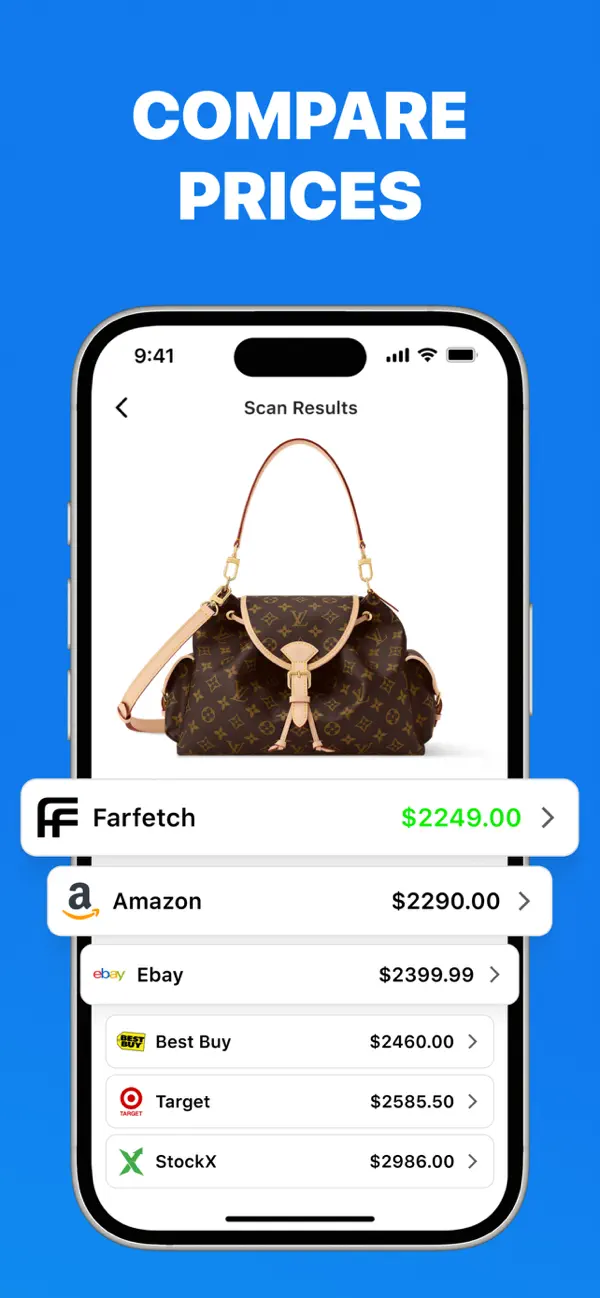
- Scan it with a price comparison app. The free QR Code Scanner * Barcode Reader app for iPhone and iPad (iOS 16 or later) reads UPC, EAN and ISBN barcodes and shows the product with prices from Amazon, eBay, Best Buy, Target, Farfetch and StockX. Reading the code works offline; the price lookup needs an internet connection. Every feature is free to use up to a usage limit; an optional Premium in-app purchase removes the limits.
- Use the store's own scanner. Many supermarkets and big-box stores have a price-check kiosk on the sales floor or a scan feature in their app that shows that store's price for the item.
- Type the number into a search engine. The digits under the barcode are the product number. Searching all 12 or 13 digits usually finds the product page and shopping results without any app.
- Read the label for weighed items. For a deli or meat package, the price is printed on the label next to its barcode, and the in-store number can't be looked up anywhere else.
For a step-by-step walk-through of checking prices in a store, see our guide to comparing prices by scanning a barcode. If your phone doesn't react to a barcode at all, our guide on how to scan a barcode on iPhone explains why the built-in Camera isn't enough.
Can you scan a QR code for the price?
A QR code contains whatever text its creator put into it, so it shows a price only if the business encoded one, which is rare; most QR codes on products and shelf tags hold a web link to a product page. Scanning the QR code opens that page, where the price may be listed. If you need a price comparison, scan the product's regular barcode instead, because that number is what price databases use.
Find the price behind any barcode
Scan UPC, EAN and ISBN barcodes and compare prices across major retailers. Free, no ads, no sign-up.
Frequently asked questions
Does a barcode contain the price?
No, not on most products. A standard UPC or EAN barcode holds only a 12- or 13-digit product number (GTIN); the store's checkout system looks that number up in its own price file. The exceptions are labels printed in the store for weighed items such as meat, deli and cheese, and the small 5-digit add-on next to many book barcodes.
How do I find the price of an item by scanning the barcode?
Scan the barcode with an app that looks the product number up online, such as a price comparison scanner, the store's own app or a price-check kiosk in the store. The barcode only identifies the product, so the price you see comes from the retailer's or the app's database and needs an internet connection.
Why does the barcode on my meat or deli package start with a 2?
A barcode starting with 2 on a package weighed in the store is an in-store number, which GS1 calls a Restricted Circulation Number. The store's scale prints it with an item code and the price or weight of that exact package, which is why it only works at that retailer.
What does the 5 digit number next to the ISBN barcode on a book mean?
It is the price add-on. In the US, a code starting with 5 gives the suggested retail price in US dollars, so 52495 means $24.95, while 90000 means no price is encoded. The bookstore still charges what its own system says.
Is the price on a barcode the same in every store?
A regular product barcode has no price in it, so every store sets its own price for the same barcode number. That is why scanning one barcode can show different prices at Amazon, Target or Best Buy.